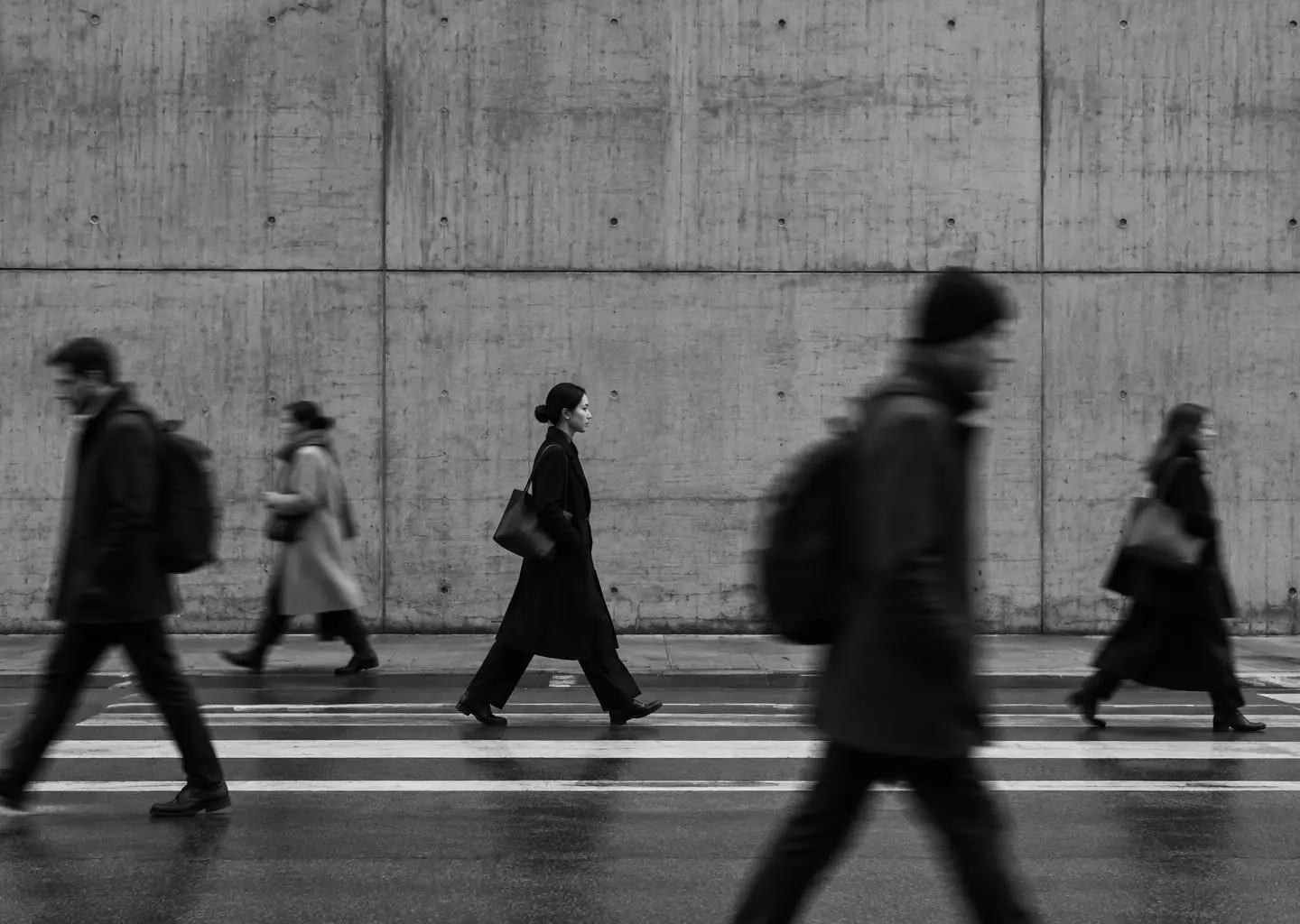

There is a phenomenon I find increasingly fascinating in AI-assisted creative work.
As the technology becomes more capable, the average quality of what people can produce appears to improve.
More people can communicate their ideas visually. More businesses can create polished materials. More individuals can develop concepts that would previously have required access to specialized creative talent.
This is an extraordinary development.
But I wonder whether there is an unintended consequence.
What if the democratization of creative capability also contributes to the homogenization of creative expression?
What if everything gets better, but more things begin to feel the same?
The creativity paradox
In July 2024, researchers Anil Doshi and Oliver Hauser published a study in Science Advances examining the effects of generative AI on creative writing.
Participants produced short fictional stories under different conditions, with some receiving access to AI-generated ideas.
The researchers found that access to AI improved the perceived creativity of the resulting stories, particularly for participants who initially demonstrated lower creative aptitude.
Participants who could access five AI-generated ideas produced stories rated approximately 8.1% higher in novelty than the human-only group.
However, the researchers also found that AI-assisted stories were more similar to one another.[1]
More dispersed
More convergent
The dot diagram illustrates the study's finding conceptually; it is not the original experimental data. Source: Doshi & Hauser, Science Advances, 2024.
The technology improved individual creative performance while reducing diversity across the collection of outputs.
That is an interesting tension.
What benefits the individual may not necessarily benefit the creative ecosystem as a whole.
The experiment involved short fiction rather than professional art direction or advertising. Its findings should not be treated as proof that every creative industry will experience the same effect.
But the underlying possibility deserves attention.
Convergence in commercial creativity
Commercial creative work has always experienced periods of convergence.
Design trends emerge and become widely adopted.
Businesses observe successful competitors and imitate aspects of their visual identity, communications and customer experiences.
Platforms introduce preferences that influence the formats people create.
Popular approaches become familiar, and familiarity can gradually become convention.
Generative AI may accelerate some of these dynamics.
When large numbers of people use similar systems to answer similar creative briefs, the resulting work may share common characteristics.
This is particularly relevant when users accept the first satisfactory output rather than actively developing an independent direction.
The output may be competent.
It may even be beautiful.
But it may be difficult to distinguish from the work surrounding it.
For businesses, that creates a strategic problem.
Much of the commercial value of creativity comes from differentiation.
If creative capability becomes more accessible while creative expression becomes more uniform, organizations may find themselves investing in increasingly polished ways of becoming less distinguishable.
The importance of creative friction
I think part of the value of a traditional creative process comes from its imperfections.
The initial concept that doesn’t quite work.
The unexpected interpretation of a brief.
The disagreement between collaborators.
The limitations of a material.
The accidental discovery that leads somewhere more interesting.
Creative friction can produce opportunities that would not emerge from a perfectly efficient workflow.
This doesn’t mean inefficiency is inherently desirable.
It means that not every obstacle should be removed without understanding what role it plays.
Some constraints encourage originality.
A limited budget can force a team to develop an unexpected solution.
An unusual environment can influence the character of an experience.
Different professional backgrounds can produce ideas that would be unlikely to emerge from a more homogeneous team.
If AI removes the wrong kinds of friction, it may inadvertently remove some of the conditions that contribute to distinctiveness.
Using AI to diverge rather than converge
I think the opportunity is to use AI intentionally as a mechanism for exploration.
The traditional design process already offers a useful framework.
The Design Council’s Double Diamond describes four phases of design: Discover, Define, Develop and Deliver. Its structure incorporates periods of expansive exploration followed by more focused decision-making.[2]
Generative AI can support this process, but it should not eliminate it.
Instead of asking a model to produce the answer, a creative team could use it to explore alternative interpretations of the problem.
Instead of generating more variations of a single concept, the team could investigate different conceptual territories.
Instead of beginning with a generated design, the team could begin with original research, independent observations and human-generated ideas.
The objective would be to expand the range of possibilities without prematurely anchoring the work to a familiar solution.
A proposed framework for maintaining originality
I would encourage creative organizations to experiment with five practices.
Begin independently
Develop initial thoughts, sketches and observations before introducing AI-generated concepts.
This creates a human point of departure rather than immediately adopting the model’s framing.
Introduce unusual inputs
Explore ideas from disciplines, cultures, historical periods and environments outside the immediate creative category.
Use original photography, research and appropriately licensed materials to introduce context that is specific to the project.
Generate conceptual differences
Distinguish between generating ten visual variations and exploring ten genuinely different ideas.
The latter is more likely to challenge assumptions.
Make deliberate editorial decisions
Require someone to articulate why a direction is interesting, appropriate and distinctive.
Don’t mistake visual polish for conceptual quality.
Establish an originality review
Evaluate the work alongside competing brands, previous industry campaigns and the organization’s own creative history.
Ask whether the work contributes something recognizable and specific.
These practices are proposals, not scientifically validated guarantees of originality.
Their purpose is to preserve space for independent thinking within increasingly automated creative workflows.
Taste as a competitive capability
If the baseline quality of creative production increases, I suspect the commercial importance of taste will increase with it.
Not taste in the narrow sense of personal aesthetic preference.
Taste as an informed understanding of context, quality, coherence, relevance and distinction.
The ability to recognize when something is technically impressive but conceptually uninteresting.
The ability to distinguish novelty from novelty for its own sake.
The ability to identify an idea that communicates something a particular audience genuinely cares about.
AI can help generate possibilities.
But a creative organization still needs a perspective from which to evaluate them.
Without that perspective, greater production capability may simply create greater volumes of familiar work.
The future of originality
I don’t believe the homogenization of creative expression is inevitable.
Generative AI can also introduce unexpected combinations, enable unfamiliar artistic approaches and give previously excluded creators access to new forms of expression.
The technology could increase cultural diversity or reduce it.
Much depends on how it is developed, distributed and used.
The interesting question is whether creative organizations will recognize originality as something that requires deliberate investment.
If everyone gains access to increasingly sophisticated creative capabilities, the ability to produce something polished may become a less meaningful distinction.
The ability to produce something unmistakably different may become more important.
Perhaps the future of creativity is not about generating better answers.
Perhaps it is about becoming more interesting in the questions we ask.
⸻
Sources & further reading
[1] Doshi, A. R., & Hauser, O. P. (2024). Generative AI enhances individual creativity but reduces the collective diversity of novel content. Science Advances, 10(28). https://doi.org/10.1126/sciadv.adn5290
[2] Design Council. History of the Double Diamond. https://www.designcouncil.org.uk/resources/the-double-diamond/history-of-the-double-diamond/