
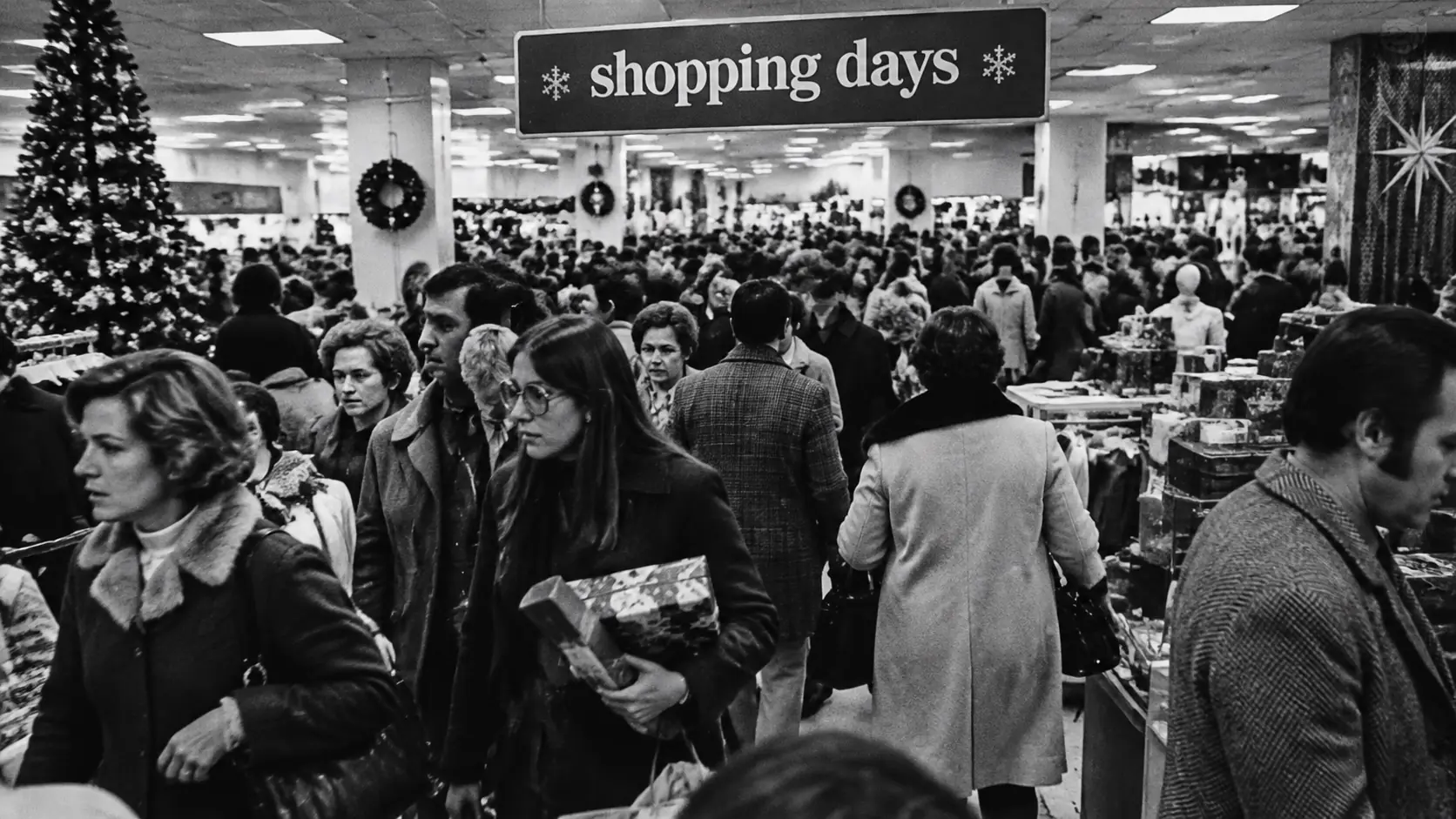
There was a time when Black Friday felt like an event.
People woke up before sunrise. Families planned their shopping routes around opening times. Parking lots filled before stores unlocked their doors. Advertisements promised extraordinary prices on products available in limited quantities.
There was anticipation, competition and a genuine sense of occasion.
Today, the experience feels different.
Black Friday arrives in our inboxes weeks before Thanksgiving. Early-access promotions become Black Friday promotions, which become Cyber Monday promotions, which become extended Cyber Monday promotions.
The countdown reaches zero, only for another one to begin.
Somewhere along the way, Black Friday stopped being a day and became a season.
Yet the commercial significance of Black Friday has not disappeared. In fact, online spending continues to reach new records.
This creates an interesting contradiction.
How can something feel increasingly ordinary while becoming increasingly successful?
And what does that tell us about the relationship between scarcity, consumer behavior and commercial strategy?
The origins of a shopping phenomenon
The term Black Friday did not originally describe a celebration of retail profitability.
Its association with post-Thanksgiving shopping emerged in Philadelphia during the middle of the twentieth century, where police used the expression to describe the congestion and disruption accompanying crowds in the city.[1]
Retailers subsequently developed a more favorable interpretation, associating the day with businesses moving from financial losses, represented by red ink, into profitability, represented by black ink.
That explanation became part of the cultural mythology surrounding the event, rather than its original historical meaning.
By the late twentieth century, Black Friday had developed into a recognizable American shopping tradition.
Its commercial structure was relatively straightforward: concentrate demand into a limited period by offering compelling discounts, restricted availability and the possibility of missing out.
But its significance extended beyond pricing.
Black Friday became a collective experience.
People planned for it, talked about it and participated in it alongside millions of others. Shopping became a cultural ritual rather than merely an economic transaction.
For retailers, that combination was extraordinarily valuable.
They were not simply creating demand. They were creating an occasion for demand.
The psychology of the original Black Friday
The traditional Black Friday model brought together several well-established principles of consumer psychology.
Scarcity
In 1975, Stephen Worchel and colleagues published research investigating how the availability of an object influenced its perceived value.
Participants evaluated cookies presented in containers with different quantities. Under certain experimental conditions, the less available cookies received more favorable evaluations.[2]
The research illustrates how scarcity can influence desirability, even when the underlying product remains unchanged.
Black Friday transformed scarcity into a commercial experience.
Limited quantities, restricted opening hours and exclusive offers created circumstances in which delaying a decision could mean losing the opportunity entirely.
Loss aversion
Daniel Kahneman and Amos Tversky's prospect theory introduced a framework for understanding how people evaluate gains and losses relative to reference points.[3]
People do not necessarily respond to equivalent gains and losses symmetrically.
In the context of Black Friday, the perceived opportunity to save money can gradually become something a consumer feels they might lose.
A person who had no intention of purchasing a television may begin evaluating the transaction according to the potential loss of a $400 discount.
The decision shifts from whether the television is worth purchasing to whether the opportunity is worth missing.
This is an application of behavioral theory, rather than evidence that every promotional purchase results from loss aversion.
Nevertheless, it illustrates the importance of framing.
Reference pricing
A product advertised at $700 may feel expensive.
The same product advertised at $700, reduced from $1,200, may feel remarkably attractive.
Research into mental accounting and transaction utility helps explain why consumers evaluate purchases partly in relation to the perceived attractiveness of the deal.[4]
The satisfaction associated with obtaining a discount can become distinct from the utility provided by the product itself.
Black Friday brought these mechanisms together within a concentrated commercial environment.
Limited time. Limited availability. Highly visible savings. Collective participation.
The conditions surrounding the purchase were often as psychologically significant as the purchase itself.
From the store to the screen
The emergence of e-commerce fundamentally altered the conditions under which Black Friday operated.
In 2005, the retail industry introduced the term Cyber Monday to describe the growing importance of online shopping following Thanksgiving weekend.
Initially, Black Friday and Cyber Monday represented relatively distinct shopping occasions.
One was associated primarily with physical retail. The other with digital commerce.
Over time, that distinction became increasingly difficult to maintain.
Retailers developed sophisticated e-commerce platforms. Smartphones made online shopping continuously accessible. Delivery infrastructure improved. Digital advertising allowed businesses to communicate with customers before, during and after traditional shopping events.
The pandemic accelerated the movement toward online purchasing, although the transition had already been underway for years.
- 1960s–1990sThe physical event
Store queues, limited inventory, opening hours and doorbuster promotions.
- 2000sThe digital expansion
Cyber Monday emerges. Retail competition expands beyond physical locations.
- 2010s–2020sThe promotional season
Mobile commerce, early-access offers, extended sales and continuous customer engagement.
- 2026 and beyondThe intelligent marketplace
Emerging AI-assisted discovery, price monitoring and automated comparison shopping.
Editorial interpretation of overlapping historical developments. The final stage represents an emerging direction, not an established endpoint.
The scale of the change is visible in Adobe Analytics' historical spending estimates.
In 2019, American consumers spent approximately $7.4 billion online on Black Friday.
By 2025, that figure had reached $11.8 billion.
On November 27, 2026, online Black Friday spending reached approximately $13.1 billion, according to Adobe data reported by Reuters the following day.[5][6]
That represents an increase of roughly 77% compared with 2019 in nominal dollar terms.
US ONLINE BLACK FRIDAY SPENDING
Source: historical Adobe Analytics estimates and Reuters reporting, November 28, 2026. US online spending only, not adjusted for inflation.
These figures measure online spending rather than total retail activity. They are not adjusted for inflation, and they do not independently establish whether retailers became more profitable.
But they demonstrate something important.
Black Friday has not become commercially irrelevant.
Its center of gravity has changed.
When scarcity becomes scalable
Scarcity was once partly a consequence of physical limitations.
A store could only stock so many televisions. A shopping center could only accommodate so many customers. A retailer could only operate within certain hours.
Digital commerce removed or reduced many of those constraints.
Retailers could reach customers continuously, offer promotions across entire product catalogs and adjust campaigns in response to changing demand.
This created a new commercial opportunity.
Instead of concentrating purchasing activity into a single day, businesses could extend the promotional period.
Early Black Friday.
Black Friday Week.
Cyber Week.
Extended holiday savings.
The logic is understandable.
Starting earlier allows retailers to compete for consumer budgets before those budgets have been spent elsewhere.
Extending promotions creates additional opportunities to convert customers who did not purchase during the original window.
Spreading demand can also help retailers manage fulfillment, inventory and operational capacity.
But there is a potential cost.
The psychological effectiveness of scarcity depends partly on its credibility.
When an offer repeatedly returns, consumers may learn that its disappearance is unlikely to be permanent.
When everything is presented as a special opportunity, the distinction between ordinary and extraordinary becomes less meaningful.
The marketing mechanism may continue generating sales while gradually weakening the expectations that originally made it effective.
Original conceptual hypothesis: repeated promotional events may weaken perceived urgency when customers expect offers to return. This is not an empirical curve, and promotional fatigue will vary by customer, product and market.
The economics of conditioning customers
One of the more interesting consequences of continuous promotions is their potential to change what customers consider a normal price.
Research on reference pricing distinguishes between the prices consumers encounter externally and the internal expectations they develop through previous experience.[7]
If a product is repeatedly discounted from $500 to $350, consumers may gradually come to regard $350 as its expected price.
The official retail price remains $500.
The psychological reference price may not.
This creates a difficult strategic problem.
A promotion designed to generate additional demand today may influence the customer's willingness to pay tomorrow.
A business can therefore increase short-term sales while creating longer-term dependence on promotional activity.
Retailers must distinguish between sales that represent genuinely incremental demand and sales that have simply been shifted forward from another period.
A customer who would have purchased a product at full price in December but instead purchases it at a discount in November creates revenue during Black Friday.
Whether the promotion created additional economic value is a different question.
The accumulation of record-breaking sales figures tells us relatively little about the quality of the underlying growth.
Revenue is not the same as commercial success
Imagine a retailer selling a product for $100 with a unit cost of $60.
At full price, each sale contributes $40 toward covering operating expenses and generating profit.
The retailer introduces a 20% Black Friday discount.
The selling price becomes $80, and the contribution per unit falls to $20.
To generate the same total contribution, the retailer must sell twice as many units.
A 20% discount requires approximately 100% more unit sales to maintain the same gross profit.
Illustrative financial model assuming constant unit cost. Excludes marketing expenses, fulfillment costs, customer lifetime value and inventory considerations.
That calculation assumes constant unit costs and excludes additional campaign expenditure, fulfillment costs and other variable expenses.
It illustrates why promotional success cannot be evaluated through revenue alone.
A business may report dramatically higher sales while retaining less value from each transaction.
Of course, discounting can serve legitimate strategic objectives.
Clearing aging inventory. Acquiring valuable new customers. Introducing people to a broader product ecosystem. Improving cash flow. Encouraging repeat purchasing.
The important distinction is whether those objectives justify the economic cost of the promotion.
Black Friday should not be evaluated simply by asking how much was sold.
It should be evaluated by asking what the business gained.
The disappearance of the shopping ritual
There is another dimension to this transition that I find particularly interesting.
The original Black Friday involved physical participation.
It required preparation, movement, social interaction and, occasionally, considerable inconvenience.
From an efficiency perspective, many of those characteristics were undesirable.
Online shopping removed much of that friction.
But friction and significance are not always opposites.
Research published by Kathleen Vohs and colleagues in 2013 examined how ritualized behavior influenced consumption experiences.
Across several experiments, participants who engaged in particular rituals reported enhanced aspects of enjoyment.[8]
Those experiments did not investigate Black Friday specifically. Nevertheless, they offer an interesting framework for considering how the rituals surrounding an activity can influence its meaning.
The preparation for a purchase, anticipation of an event and participation alongside other people can contribute to the experience itself.
Digital commerce has made purchasing considerably more convenient.
Whether it has made shopping more emotionally engaging is a separate question.
Perhaps part of what people remember about the original Black Friday is not the exceptional discounts.
Perhaps it is the experience of participating in something that felt temporary, collective and culturally recognizable.
Black Friday in the age of artificial intelligence
The next major transformation may involve the delegation of shopping decisions themselves.
In the past, consumers gathered advertisements, compared store prices and manually evaluated competing offers.
Digital commerce accelerated that process.
AI could increasingly automate it.
A shopping assistant might monitor historical prices, evaluate product specifications, compare retailers, identify misleading discounts and notify someone when a genuinely attractive opportunity becomes available.
This introduces a potentially significant change in the relationship between businesses and consumers.
Marketing has traditionally influenced human perception through visual presentation, emotional associations, framing and persuasive communication.
An AI intermediary may evaluate offers differently.
It might place greater emphasis on historical pricing, product specifications, reliability, customer reviews and the explicit preferences of its user.
That does not mean AI-mediated commerce becomes perfectly rational. Algorithms can introduce their own biases, commercial incentives and errors.
But it could change which characteristics make an offer competitive.
There are already early indications of this transition.
Reuters' reporting on Black Friday 2026 highlighted the increasing commercial relevance of shopping traffic originating from AI tools.[6]
The longer-term implications remain uncertain.
But if customers increasingly delegate comparison shopping to intelligent systems, retailers may find it more difficult to rely exclusively on the appearance of a compelling deal.
A discount might need to withstand independent scrutiny.
A premium price might need to be supported by demonstrable differentiation.
A limited-time offer might need to represent a genuinely limited opportunity.
The future of promotional pricing could involve a competition not only for human attention, but for the recommendation of the systems through which humans make decisions.
Three possible futures for Black Friday
I see three overlapping directions in which Black Friday could evolve.
1. The continuous promotional marketplace
Black Friday increasingly becomes a recognizable label within a much longer period of seasonal promotions.
Retailers compete through dynamic pricing, personalized offers, fulfillment capabilities and customer acquisition strategies.
The distinction between Black Friday and the surrounding shopping period continues to weaken.
2. The intelligent shopping economy
AI-assisted consumers become better equipped to evaluate whether an advertised discount represents meaningful savings.
Retailers compete through verifiable value, accessible product information, reliable service and credible pricing history.
Promotional effectiveness becomes more dependent on the substance of the offer.
3. The return of experience
Some retailers deliberately reintroduce elements of occasion, participation and meaningful scarcity.
Instead of competing exclusively through larger discounts, they develop exclusive experiences, carefully curated product releases, personalized service and reasons for people to participate beyond the transaction itself.
In this scenario, physical retail does not compete with digital commerce by attempting to become equally efficient.
It competes by providing something different.
These are strategic possibilities rather than predictions of inevitable outcomes.
Different retail categories may evolve in different directions.
What businesses should learn from Black Friday
The evolution of Black Friday offers lessons that extend beyond retail.
Successful marketing mechanisms can become less distinctive through repetition.
Customers adapt to the incentives organizations create.
Short-term revenue growth can conceal long-term economic compromises.
And efficiency can sometimes remove characteristics that contributed to the original value of an experience.
I think businesses should become increasingly deliberate about distinguishing between three things:
Creating genuine value.
Communicating genuine value.
Creating the perception of value without a corresponding improvement in the underlying offer.
The first builds the business.
The second helps customers understand it.
The third may generate transactions, but it is more difficult to sustain.
Black Friday is not disappearing. The spending data makes that clear.
What may be disappearing is its original psychological architecture: a distinctive occasion, a credible sense of scarcity and a shared cultural experience.
Perhaps those characteristics will become increasingly valuable as the retail environment becomes more continuous, automated and abundant.
After all, when every day becomes a special occasion, creating something that actually feels special becomes considerably more difficult.
References
[1] HISTORY. History of Black Friday: Shopping on Thanksgiving. https://www.history.com/articles/black-friday-thanksgiving-origins-history
[2] Worchel, S., Lee, J., & Adewole, A. (1975). Effects of supply and demand on ratings of object value. Journal of Personality and Social Psychology, 32(5), 906–914. https://doi.org/10.1037/0022-3514.32.5.906
[3] Kahneman, D., & Tversky, A. (1979). Prospect Theory: An Analysis of Decision under Risk. Econometrica, 47(2), 263–291. https://doi.org/10.2307/1914185
[4] Thaler, R. (1985). Mental Accounting and Consumer Choice. Marketing Science, 4(3), 199–214. https://doi.org/10.1287/mksc.4.3.199
[5] Adobe Analytics historical Black Friday spending estimates, 2019–2025, compiled in Black Friday Sales by Year and History. https://www.blackfridaystatistics.com/history
[6] Reuters. (November 28, 2026). US Black Friday online spend rises 11% to a new high of $13.1 billion. https://www.reuters.com/business/retail-consumer/black-friday-online-shopping-rises-131-billion-us-adobe-analytics-data-shows-2026-11-28/
[7] Mazumdar, T., Raj, S. P., & Sinha, I. (2005). Reference Price Research: Review and Propositions. Journal of Marketing, 69(4), 84–102. https://doi.org/10.1509/jmkg.2005.69.4.84
[8] Vohs, K. D., Wang, Y., Gino, F., & Norton, M. I. (2013). Rituals Enhance Consumption. Psychological Science, 24(9), 1714–1721. https://doi.org/10.1177/0956797613478949